Monday, February 25, 2013

Add 0078

Susheela Raman hails from the movement of immigrant and second-generation musicians from the Indian subcontinent based in Britain, who perform a fusion of traditional and classical forms from their homeland with contemporary beats and dancehall tracks from Western Europe. Raman was born to immigrant parents in London in 1973, and her family soon moved closer to the subcontinent, taking a home in Australia, where she soon started learning and performing South Indian classical song. With a bevy of recitals under her belt, she began working with more blues-based music (soul, rock, R&B) for a while, alternating between that and new studies in Hindustani song withShruti Sadolikar. Returning to England within a few years, she began work on the idea of fusing Indian classical forms with more contemporary Western ones. Aided by Sam Mills, who had done similar projects with one of the contemporary Baul singers, Raman worked with a huge number of foreign artists on the Salt Rain project, released in 2001. She was nominated as the first world music artist for the British Mercury Prize, and satisfied with the results of Salt RainRaman used the same basic guidelines to create Love Trap, released in mid-2003.


1 4:34

2 7:13

3 3:44

4 6:31

5 7:11

6 3:27

7 3:48

8 4:03

9 6:34

10 3:20

11 3:01

aCá

Sunday, February 24, 2013

add 0075

You would be hard pressed to find another recording where a flamenco guitarist interprets the music ofBill Evans. This one has Nino Josele playing select pieces performed and beloved by the modern jazz piano icon, and in three instances composed by him. A variety of settings are used, from solo acoustic guitar, some duo and vocal efforts, guitar-bass-drums, and a few guest cameos. The sound of Joselethrough Evans is thoughtful, introspective, facile, understated and romantic. Dynamics are shaded with a sweet restraint aside confidence in doing the music justice. The CD opens with the perfect prologue, theEvans overture "Peace Piece," as delicate and pristine a composition as anyone has ever written, played perfectly. Then the pace quickens as Josele and his trio kick up "Waltz for Debby," at first in typical 3/4 time, then in a higher 4/4 gear. The third Evans evergreen "Turn out the Stars" is more typically in flamenco style apart from all the other selections, again with the trio. There are six standards, the highlights being solo guitar samplings of "When I Fall in Love" and a multitude of distinct Spanish styles showcased during "The Dolphin," Jimmy Rowles ballad "The Peacocks" accented by Joe Lovano's piquant tenor sax, and Tom Harrell's trumpet playing an extrapolated melody on the second time repeat during "My Foolish Heart." "Hullo Bolinas" of Steve Swallow may be the unexpected choice of the recording, another slow ballad (of many) done with guitar and Marc Johnson's bass only. Also unexpected but less effective is Freddy Cole's reading of Paul Simon's "I Do It for Your Love." As a whole this project is well paced and placed, executed with plenty of soul, and should prove a discovery for those not familiar with Josele's excellent musicianship.

aCá

add 0076


TrkSong
1Muerte de Juan Tango
(with with Agri Antonio, Mosalini Juan Jose)
2Apretonados
(with with Agri Antonio, Mosalini Juan Jose)
3Encuentro
(with with Agri Antonio, Mosalini Juan Jose)
4Desde Adentro
(with with Agri Antonio, Mosalini Juan Jose)
5Sonagasata
(with with Agri Antonio, Mosalini Juan Jose)
6Homenaje a Tres Amigos
(with with Agri Antonio, Mosalini Juan Jose)
7Aller Retour II
(with with Agri Antonio, Mosalini Juan Jose)
8Tristezas de un Doble a
(with with Agri Antonio, Mosalini Juan Jose)
9Recuerdos de Provincia
(with with Agri Antonio, Mosalini Juan Jose)
10Naomi
(with with Agri Antonio, Mosalini Juan Jose)

add 0077


From Wikipedia, the free encyclopedia

Cover is a 2009 cover album by Joan as Policewoman. The limited edition physical CD version of the album was sold through Joan's official website and at her live shows. The digital version of the album does not include the opening track "Fire".


[edit]Track Listing

No.TitleWriter(s)Length
1."Fire(Jimi Hendrix)Jimi Hendrix5:14
2."Overprotected(Britney Spears)Max MartinRami2:53
3."Ringleader Man" (T-Pain)Faheem Najm, Johnny Smith3:34
4."Baby" (Iggy Pop)Iggy Pop, David Bowie4:10
5."Whatever You Like(T.I.)Clifford Harris, James Scheffer, David Siegel4:23
6."Lady" (Adam and the Ants)Adam and the Ants3:15
7."She Watched Channel Zero!?" (Public Enemy)Carlton RidenhourRichard GriffinHank ShockleeEric SadlerWilliam Drayton5:13
8."Sacred Trickster" (Sonic Youth)Sonic Youth2:43
9."Sweet Thing(David Bowie)David Bowie3:13
10."Keeper of the Flame" (Nina Simone)Charles Derringer8:53
Total length:
43:27

Saturday, February 23, 2013

add 0074

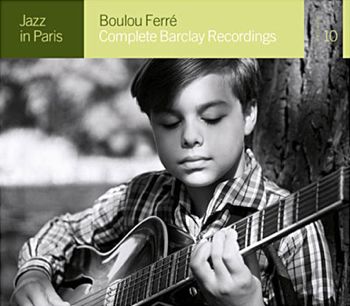
Boulou Ferré
Complete Barclay Recordings
Jazz in Paris Vol.10

publié par Francis Couvreux

Bonne idée que cette intégrale des titres enregistrés par le jeune Boulou Ferré par Barclay, 30 morceaux couvrant les années 64 à 74, qui étaient devenus rarissimes et que les jeunes générations vont découvrir.
Né en 1951, Boulou a commencé la guitare jazz en 57 avec Matelo Ferret, son père, étudiant parallèlement la guitare classique avec Francisco Gill. Cet enfant précoce (à 7 ou 8 ans, un âge où ses petits camarades fredonnent des chansonnettes, Boulou chantait lui, les chorus de Gillespie !) donne son premier concert en 59 an musée Guimet, enregistre son premier disque en 63 avant de faire l’année suivante la première partie de Coltrane au festival d’Antibes. Si Boulou révère Django (cf son intelligente relecture de Nuages en 66, avec un long exposé aux accents classiques qui suit d’ailleurs une interprétation en solo d’une pièce d’Albeniz, et que les jeunes manouches bouillonnants d’aujourd’hui feraient bien d’écouter), il est aussi fan de Jimmy Raney ou Tal Farlow.
Alain Antonietto, qui a bien connu la famille Ferret à cette époque, rappelle dans un livret érudit et précis, comme à son habitude, que « le jeune Boulou affectionnait les rencontres instrumentales avec les plus novateurs de ses proches, Laro Sollero ou René Mailhes », écumant les clubs parisiens et jammant avec des pointures comme Jean Luc Ponty, René Thomas ou Eddy Louiss. Bref, le décor est planté ; pas de manoucheries ici mais du jazz joué par un guitariste libre à l’incroyable bouillonnement créatif ; Les premiers 45 tours de Boulou seront alors un vrai choc (cf Roll’em pete qui ouvre le CD), le jeune homme devenant une vedette qui excède la stricte sphère du jazz ; on peut le comprendre quand on se reporte aux années 64-65 ; qu’y avait-il alors en France musicalement ? Après un impressionnant 45 tours à la maturité incroyable consacré à Gillespie, où il double ses chorus de sa voix prépubère , Boulou enregistre en 66 huit titres avec le Paris all stars ; propulsé par Pierre Gossez, sax, Guy Boyer, vibra, Eddy Louiss, orgue, Michel Gaudry, contrebasse et André Arpino, batterie, il fait feu de tout bois alternant ballades au climat recueilli (cf sa magnifique version de Moonlight in Vermont) et versions enlevées de standards comme How high is the moon sur lesquels son phrasé souvent imprévisible conjugue de « fulgurantes illuminations, des débordements plein de générosité et d’intarissables improvisations »(AA).
En 74, à 19 ans, Boulou est un musicien complet qui a étudié aussi avec Messiaen ; ouvert à tous les courants, après une expérience free jazz aux côtés de Gunther Hampel, il continue ses expériences musicales avec le Corporation Gypsy Orchestra, composé d’une section de cuivres, d’André Hervé à l’orgue, Richard Fistich à la basse, Alain Clarel aux percussions et Takashi Kako (venu lui aussi étudier dans la classe de Messian) piano, harmonium et clavecin ; un disque allumé bien dans l’air du temps des années 70, inspiré notamment par un certain Jimi Hendrix. Boulou n’est plus seulement un guitariste improvisateur mais un compositeur et orchestrateur (arrangements très travaillés) essayant d’associer dans un concept la musique classique et le jazz-rock (le groupe se produira au Gibus où Santana, Stanley Clarke et Lenny White (alors avec Chick Coréa) viendront l’écouter. Il y cultive le mélange des genres avec une totale liberté et quelques belles réussites (cf la rose des vents ou Mona Lisa avec un solo de guitare électrique très zappaïen.
Sans aucun doute LA réédition de l’année !
http://www.djangostation.com
DISQUE 1
1. Roll’Em Pete 02:26
2. C’Est Si Bon 02:42
3. I’ll Never Smile Again 02:27
4. The Girl From Ipanema 03:10
5. Salt Peanuts 02:29
6. Ow ! 03:18
7. A Night In Tunisia 03:45
8. Blue’n’Boogie 003:52
9. Groovin’ High 03:50
10. Undecided 02:20
11. Ascot 03:14
12. Samba De Uma Nota So 03:19
13. Yesterdays 03:40
14. Boulou’s Theme 02:57
15. Moonlight In Vermont 03:22
16. Asturias 05:23
17. Nuages 04:39
18. How High The Moon 02:42
19. Tenderly 04:55
20. All The Things You Are 05:06

DISQUE 2
1. Bluesette 02:58
2. La Complainte De Mackie 02:19
3. Dieu Merci, Elle M’Aime Aussi 02:55
4. Night And Day 02:36
5. Cervantes 03:07
6. Cuando Sali De Cuba 02:21
7. Aranjuez 03:18
8. Prélude Pour Marielle 01:12
9. Nostradamus (Maleous Maleficarum) 03:44
10. La Rose Des Vents 05:54
11. Samouraï 05:49
12. Mona Lisa 02:36
13. Enterre Mon Coeur 04:30
14. Amour Cibernétique 03:03
15. Ils T’Appellent Tous Soleil 02:49
16. Boulou’s Team 05:59



add 073


Though he was present at the birth of '60s rock & roll in France, it took another 15 years for Alain Bashung's star to rise. Born in Paris in 1947, he was raised in Alsace but left home at the age of 16 to begin playing in a cover band with several friends. The group lasted several years, until Bashung began recording on his own, for Philips, in 1966. Ten years would pass before any degree of success, though he did play a prominent role in 1972's La Revolution Française, the French rock opera produced by Claude-Michel Schoenberg. In 1976, Alain Bashungbegan working with lyricist Boris Bergman and songwriter Andy Scott. The change in atmosphere proved helpful, and after test runs onBashung's long-delayed 1977 debut album and 1979's Roulette Russe, the 1980 single "Gaby, Oh Gaby" became a monster hit. After Bashung became a star and gained his first gold record that year, he then recorded another with "Vertigo de l'Amour," from the album Pizza. He fulfilled a lifelong dream in 1982 when he recorded with Serge Gainsbourg. During the mid-'80s, Bashung remained at the top of the French pop firmament, with singles like "S.O.S. Amor" and "Touche Pas à Mon Pote." He endured a fallout with critics -- and consequently, the public -- during the late '80s, but then roared back with 1991's Osez Joséphine. The album, a song cycle concerning one of the most famous women in French history, became the biggest hit of Bashung's career, selling well and earning him three Victoires de la Musique awards. The similarly thematic follow-up Chatterton followed in 1994 and in 1998 Bashungreturned to the top of the French album charts with Fantaisie Militaire. 2002 saw the release of not only the landmark album L’Imprudence but also Cantique des Cantiques with his wife Chloé MonsBleu PétroleBashung’s twelfth album came in 2008, and would become his last studio album to be released.Bashung passed away in 2009 after a battle with lung cancer, at age 69. 2011 saw the release of theL'Homme à Tête de Chou, the first posthumous Bashung album. A track-by-track reworking of Serge Gainsbourg’s album of the same name, it was originally recorded as a soundtrack to a Jean-Claude Gallotta dance show.
SampleTitle/ComposerPerformerTimeStream
1 5:07
2 3:56
3 4:12
4 4:20
5 3:56
6 4:25
7 3:26
8 3:42
9 4:05
10 4:03
11 4:37
12 3:57
aCá