skip to main |
skip to sidebar
Lamp Fall is the first international release from the Senegalese singer/songwriter and guitarist Cheikh Lô. Issued on World Circuit, it is a collection of traditional and original songs that heavily showcase his trademark mbalax drums, reggae grooves, and funky polyrhythms, with a host of colors and textures added by widely varying instrumentation. This time out, Lô goes to Brazil for inspiration -- about half the album's tracks were recorded in Bahia. Lamp Fall's opener, "Sou," is a traditional song with a radically different arrangement. It is sung in Bambara, the language Lô learned in Burkina Faso. It is a Mandinka song in origin, and comes form Mali. One can heard the Brazilian feel here in the employment of a sanfona accordion -- a close relative of the bandoneon. It is juxtaposed against a talking drum, as Lô's falsetto carries its melody -- a love song -- over. The title track was one of many recorded in Dakar and in London. Lamp Fall is a tribute to Cheikh Ibra Fall, a religious leader whose faith Lô belongs to. What's startling is the opening guitar chord, which sounds like it could have been lifted off James Blood Ulmer'sAre You Glad to Be in America? Saxophone great Pee Wee Ellis blows hard and funky here against crisscrossing rhythms by Saliou Seck, accented by a Crescent City piano vamp played by Arona Barry. The Brazilian feel comes to the fore in "Satta Kaani Xeen," where castanets, wood blocks, cajon, and berimbau make up the main body of the tune lyrically and rhythmically. The band here is large, with a sitar, tama, bass clarinet, and Paulinho Andrade's flute orchestrating the melody. Ellis is heard fiercely in "Bamba Mo Woor," over the top of twin electric guitars riffing like hell, and fronting both Bigga Morrisson's Hammond B-3 and the rest of a horn section featuring Byron Wallen on trumpet and Tim Smart on trombone. The reggae groove here is deeply dread, shuffling and slipping along a bubbling bassline and Lô's sweet -- but not saccharine -- falsetto vocals. The only pure mbalax tune here is "Fattaliku Dëmb," where Lô plays a mean flamenco-style rhythm guitar part over the rolling drums and pumped bassline. It also features a fine guitar solo by Lamine Faye. In sum, Lamp Fall is a further extension of the already heady mix of styles, rhythms, and harmonics Lô has amassed over the past decade and a half. It's an utter joy in that it's so dense that most of its secrets won't be revealed until many repeated listenings are undertaken. That said, its sunny sheen and easy, airy atmosphere are intoxicating and elegant. This is early candidate for one of the best recordings of 2006.
aCá
Betty Davis' debut was an outstanding funk record, driven by her aggressive, no-nonsense songs and a set of howling performances from a crack band. Listeners wouldn't know it from the song's title, but for the opener, "If I'm in Luck I Might Get Picked Up," Davis certainly doesn't play the wallflower; she's a woman on the prowl, positively luring the men in and, best of all, explaining exactly how she does it: "I said I'm wigglin' my fanny, I'm raunchy dancing, I'm-a-doing it doing it/This is my night out." "Game Is My Middle Name" begins at a midtempo lope, but really breaks through on the chorus, with the Pointer Sisters and Sylvester backing up each of her assertions. As overwhelming as Davis' performances are, it's as much the backing group as Davis herself that makes her material so powerful (and believable). Reams of underground cred allowed her to recruit one of the tightest rhythm sections ever heard on record (bassist Larry Graham and drummer Greg Errico, both veterans of Sly & the Family Stone), plus fellow San Francisco luminaries like master keyboardist Merl Saunders and guitarists Neal Schon orDouglas Rodriguez (both associated with Santana at the time). Graham's popping bass and the raw, flamboyant, hooky guitar lines of Schon or Rodriguez make the perfect accompaniment to these songs;Graham's slinky bass is the instrumental equivalent of Davis' vocal gymnastics, and Rodriguez makes his guitar scream during "Your Man My Man." It's hard to tell whether the musicians are pushing so hard because of Davis' performances or if they're egging each other on, but it's an unnecessary question. Everything about Betty Davis' self-titled debut album speaks to Davis the lean-and-mean sexual predator, from songs to performance to backing, and so much the better for it. All of which should've been expected from the woman who was too wild for Miles Davis.
acá
Crafting "doom-drenched electric folk," Los Angeles' Chelsea Wolfebrings a foreboding feel to songs as disparate as "You Are My Sunshine" and album tracks by Norwegian black metal icon Burzum. Wolfe grew up in Northern California with a father who had a country band and his own home studio, so she was immersed in music at an early age and began recording herself at age nine; by the time she was in fourth grade, she knew she wanted to be a singer. However, it wasn't until 2009, when she returned from a three-month tour with a performance artist friend in spaces including old nuclear factories, that she began making music for others to hear. Wolfe recorded with her friends on a portable eight-track, the results of which became her 2010 debut album, The Grime and the Glow. Wolfealso contributed a radically different version of the Strokes' "The Modern Age" to a tribute to the band curated by Stereogum.com, and her song "Moses" was used to soundtrack artist/director Richard Phillips' short film Sasha Grey. After moving to L.A., Wolfe recorded her second album, Apokalypsis, in a proper studio, working with musicians including Ben Chisholm; it was released by Pendu Sound Recordings in August 2011. Wolfe took a few musicians, including Chisolm, into the northern California woods to record Unknown Rooms: A Collection of Acoustic Songs, which was released in October 2012. Prayer for the Unborn, her contribution to Southern Records Latitudes EP series, arrived a few weeks later.
acá
ue to the international success of In the Heart of the Moon, Mandé lineage griot Toumani Diabatéwanted to make a follow-up with fellow Malaian, the legendary guitarist Ali Farka Touré. The first record had been cut in Niafunke, Touré’s home village in the north of Mali, Diabaté contacted World Circuit'sNick Gold about doing the follow-up in London, where the pair was due to play a couple of concerts.Gold agreed and suggested they include Cuban bassist Orlando “Cachaito” Lopez on the session. There was some urgency: Touré was dying. The sessions were cut over four days in June of 2005; this is his last recording. The contents are made up of improvisations and new versions of old songs from both men’s regions. Opener “Ruby” is a gorgeous improvisation, where Touré doesn’t play the role of guitar slinger, but of a guitarist playing only for his own enjoyment, softly, gently, with his trance-like hypnotic rhythm, allowing Diabaté to let his kora flow over the modal pattern. Cachaito makes the first of five appearances here. “Sabu Yerkoy” is a proper entrance. It is Touré’s take on Cuban salsa (with his son on congas). The rhythmic interplay between drums, bass, and acoustic guitar is intricate and subtle with its gentle, seductive approach. “Doudou” is a completely new take on an old Mandé song, weaving together a Senegalese mbalax rhythm and the kora’s harmonic palette. Along the lines of the intricate melody,Touré layers one atop another from one of his own songs, with “Singya” on top. It’s easily among the most beautiful thing here. Touré’s rhythmic approach shines on “Samba Gerladio,” another new version of a very old folk song. Touré introduces it and Diabaté eventually encounters him on the chorus, weaving a new melody based on Touré’s blues. “Sina Mory” is the very first song Touré learned to play on the guitar -- this may have been the last time he played it. “Kala Djula,” a griot’s hymn, closes the set as a celebratory song. Its rhythmic feel -- held down by Cachaito -- is cut-time, but the pace is graceful, easy, relaxed. Diabaté’s soloing is breathtaking, full of humor and warmth. Touré interjects his own slippery guitar pattern, creating a second-line melody. This self-titled album is a fitting tribute to Touré’s andDiabaté’s genius and friendship, and is a beautiful farewell.
aCá
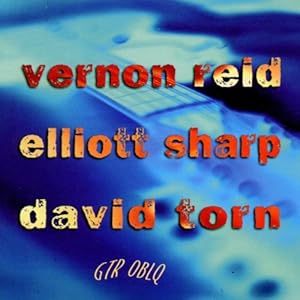
Gtrobliq ("Guitar Oblique") is an avant-jazz, superstar lineup. This guitar trio features Elliot Sharp,Vernon Reid (Living Color), and David Torn (Polytown, Jan Garbarek Quartet, Bill Bruford, Lou Reed's the Everyman Band etc.). Experimental, ambient, and multi-layered, the work of this trio is an otherworldly headspace untethered by a rhythm section. An exploration of dissonance and melody, effected guitars, and the interaction of the dissimilar, this trio's work is an impressive free-guitar alchemy from three of the instrument's most prolific and innovative players. It may seem that Reid does not fit in this lineup, but recalling the work he has done with John Scofield, Jack DeJohnette, MC 900 Ft. Jesus,DJ Logic, and more, one can see that he has proven nearly as inventive as the rest of this stellar group.
aCá
With his whiskey-and-cigarettes vocals, blues-inspired arrangements, and acerbic lyrics, Arno regularly earned comparison to gutter poets like Serge Gainsbourg and Tom Waits. Born Arno Hintjens in Ostende, Belgium, on May 21, 1949, he first surfaced in a series of little-known R&B-influenced acts, including Freckle Face and Tjens-Couter. In 1977,Arno and longtime collaborator Paul Decouter co-founded TC Bland with Ferre Baelen and Rudy Cloet, and after a name change to TC Matic, the group emerged as one of the more successful European acts of the early '80s, scoring a series of hits including "Elle Adore le Noir" and "Putain Putain." After a 1985 tour in support of Simple Minds, TC Matic split and a year later Arno issued his self-titled solo debut, written almost entirely in English. With the 1988 follow-up Charlatan, he cemented his roguish persona but also exhibited a more sensitive side via his moving cover of the Jacques Brel classic "Le Bon Dieu." Upon relocating to Paris, Arno wrote and recorded his third LP, 1990's Ratata, headlined by the hit "Lonesome Zorro." He next joined the one-offCharles et les Lulus alongside Roland Van Campenhout and Adriano Cominotto, recording an eponymous album stuffed with blues classics penned by Willie Dixon and Sonny Boy Williamson. Arnotraveled to Nashville to record his next solo effort, 1993's Idiots Savants; after another one-off collaboration, Arno et les Subrovnicks (featuring fellow TC Matic alum Cloet), he ventured into cinema, scoring the Marion Vernoux film Personne Ne M'aime.
After spending virtually the entirety of his career writing and singing in English, Arno embraced French for 1995's chart-topping Les Yeux de Ma Mere, which dabbled in genres spanning from jazz to tango. He then made his acting debut as a homosexual swimming instructor in Jan Bucquoy's Camping Cosmos, extending his hiatus from the studio by releasing a 1997 live LP, Arno (En Concert à la Française). Arno's next album, Give Me the Gift, was recorded in English and distributed exclusively in the U.S. market. The release generated little attention in the American marketplace and he returned to film, scoring Michel Piccoli's Alors Voilà and also accepting a co-starring role onscreen. Another pseudonymous blues set credited to Charles and the White Trash Blues preceded Arno's next proper solo effort, 1999's A Poil Commercial. An acoustic LP, Arno Charles Ernest, followed in 2002, highlighted by "Elisa," a duet with French pop legend Jane Birkin. With the 2005 follow-up, French Bazaar, he again recorded solely in French, and earned the Victoire de la Musique award for Best Pop-Rock Album for his efforts. Arno returned to film via 2006's Komma, the first in a series of big-screen projects including Ex-Drummer and J'ai Toujours Voulu Être un Gangster. He finally returned to music in the spring of 2007 with Jus de Box.
The follow-up to 2007's Jus de Box, Brussld is the 18th album from Belgian poet, actor, and singer Arno. The 2010 LP, his first since signing to Naive Records, features his trademark hoarse vocals, socio-political lyrics, and European blues-rock on 12 songs recorded in English and French, and includes the single "Black Dog Day." [A bonus edition featuring four new songs and acoustic versions of two of the album tracks was also released.]
aCá